


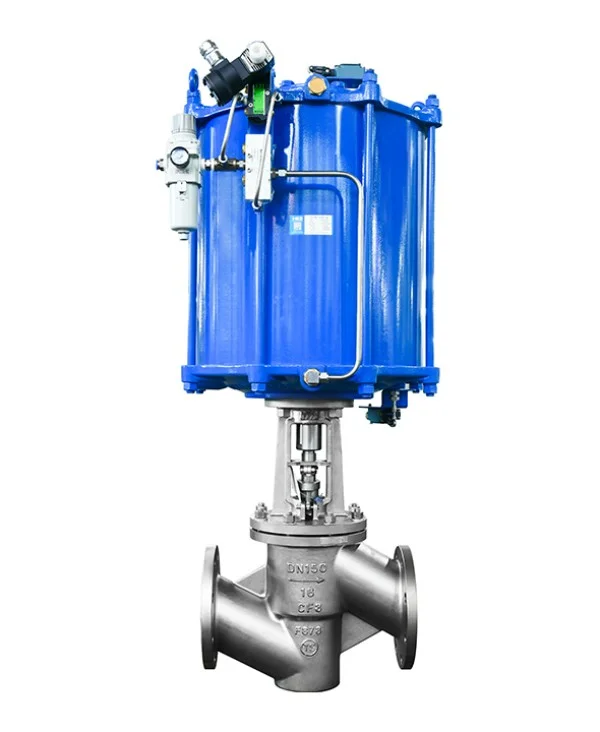
Pneumatic PTFE-Lined Globe Valve
A globe valve refers to a valve whose closing member (disc) is driven by the stem to move up and down along the central axis of the seat. In pipelines, it is mainly used to connect or cut off the medium, but it cannot be used for throttling.
 Click To Consult

Basic Structure of Globe Valve
-
Fluoroplastic fully lined Type J41F46 straight-through, Type J45F46 straight-flow, and Type J44F46 angle globe valves feature a compact structure, flexible opening/closing, strong corrosion resistance, and a short stroke (generally 1/4 of the nominal diameter). They are widely used in pipeline systems such as petroleum and chemical industries for shutting off media. However, it must be emphasized that fluoroplastic-lined globe valves are strictly prohibited for flow regulation to prevent the high-speed medium flow generated at the throttling point from eroding the sealing surface.
-
The disc and stem are designed as an integral structure to prevent the possibility of internal parts being ejected from the valve body due to pipeline pressure fluctuations, featuring a compact structure and safe use.
Design Specification: Complies with the GB/T 12235 standard.
Operation: Manual, gear drive, pneumatic (normally open or normally closed), electric.
Basic Structural Types: Straight-through, straight-flow, angle type.
Nominal Pressure: PN0.6–1.6 (MPa).
Nominal Diameter: DN15–350 (mm) (straight-through, straight-flow), DN15–300 (mm) (angle type).
Executive Standards
-
Design & Manufacture: GB/T 12233 / GB/T 12235
-
Face-to-Face Dimensions: GB/T 12221 / HG 3704
-
Flange Dimensions: HG/T 20592 (or as per contract)
-
Pressure Test: GB/T 13927
-
Marking: GB/T 12220
-
Supply: GB/T 12252


